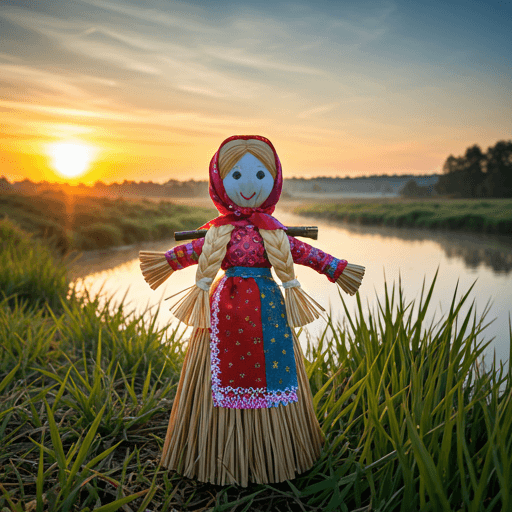
On the first day of spring, rivers across Poland receive a peculiar offering: a straw doll in a white dress, ribbons fluttering, often still smouldering. This is Marzanna — the old Slavic goddess of winter, plague, and death — and drowning her effigy is how Poland has fired winter from its job for at least six hundred years.
It is one of the oldest surviving pagan rituals in Europe, and it survived not in secret, but in plain sight: today it is performed mostly by schoolchildren on a class outing, chanting rhymes at a riverbank while their teacher checks no one falls in after the goddess.
The Goddess Who Had to Die
Marzanna (Morana to other Slavs) personified everything the winter months threatened: cold, hunger, sickness, death. Ending her reign could not be left to the calendar alone — the community had to perform it. An effigy of straw was dressed in white cloth or bridal ornaments, fixed to a pole, and carried through the village in a mock funeral procession.
The Church tried hard to stamp the custom out. A synod in Poznań in 1420 explicitly instructed clergy to forbid the 'superstitious' spring drownings; attempts were later made to replace Marzanna by throwing an effigy of Judas instead. Nothing worked. The goddess outlasted every decree.
How to Drown a Winter
The classical script: the procession dips the effigy in every trough and puddle on its way through the village, then at dusk sets the straw alight and hurls the burning Marzanna off a bridge or bank into the current — a double death, fire and water, to make absolutely sure.
Strict superstitions governed the retreat. You must not touch the floating Marzanna (your hand would wither), and you must not look back at her on the way home (illness would follow). In many regions the procession returned carrying gaik — a young green branch decorated with ribbons — walking spring into the village to fill the vacancy.
Marzanna in the Age of Homework
The rite migrated from village elders to schoolchildren, and March 21 became a fixture of Polish childhood: build a Marzanna in class, march to the nearest water, shout her off the premises. The date doubles as Dzień Wagarowicza — 'Truant's Day' — when skipping school on the first day of spring is treated with a national wink.
Ecology has amended the liturgy: since fishing straw-and-synthetic goddesses out of rivers is nobody's idea of spring renewal, many schools now drown biodegradable effigies, retrieve them downstream, or symbolically burn a paper Marzanna instead. The goddess adapts; the winter still loses.
Curious Facts
- A church synod in Poznań banned the rite in 1420 — making the ban itself the oldest written proof of the tradition.
- Folk rules of the ritual: never touch the floating effigy, and never look back at her — bad luck and illness follow those who do.
- Marzanna's counterpart is 'gaik' — a beribboned green branch carried back to the village to install spring in her place.
- March 21 is also Truant's Day (Dzień Wagarowicza) — Polish schools traditionally lose a suspicious number of pupils to 'spring'.
- Many schools now use biodegradable Marzannas, drowning the goddess with an environmental permit, so to speak.
 Support this project