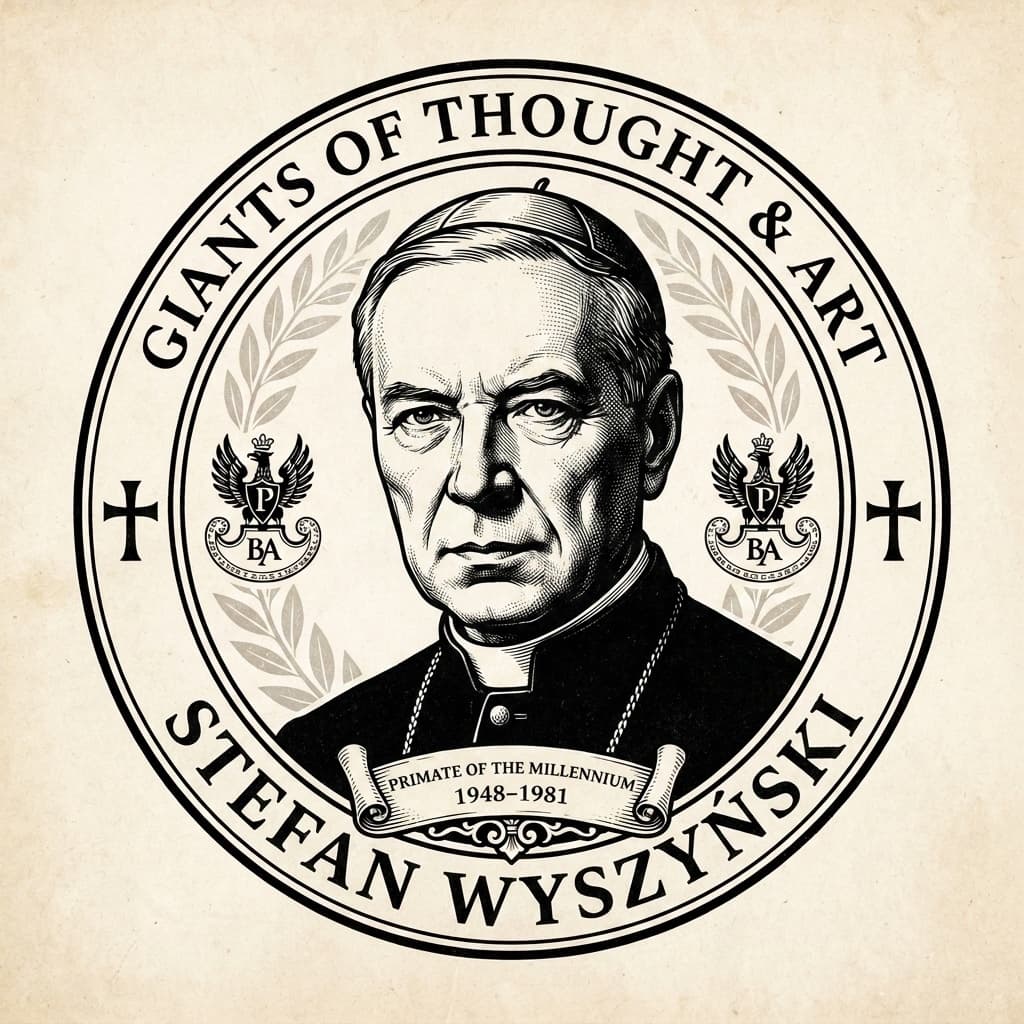
For three years, the head of the Polish Catholic Church was a prisoner of his own government. Cardinal Stefan Wyszyński spent 1953 to 1956 locked away in remote monasteries — and used the time to write a spiritual renewal programme for the entire nation.
In post-war Poland, where the communist state tried to control every institution, Wyszyński became something nobody had planned for: the de facto guardian of national identity, a man both the Vatican and the Party had to negotiate with. Poles simply call him the Primate of the Millennium.
A Priest in Dark Times
Born in 1901 in the village of Zuzela on the river Bug, Wyszyński was ordained in 1924 and became known in the 1930s for his writing on workers' rights and social justice. During the Nazi occupation he served in the underground, acting as a chaplain during the Warsaw Uprising under the codename 'Radwan III'.
In 1948, aged only forty-seven, he became Primate of Poland — the leader of the Polish Church — at the precise moment Stalinism was tightening its grip on the country.
Arrest and the Jasna Góra Vows
Wyszyński tried pragmatic coexistence with the regime, signing a controversial agreement in 1950. But when the state demanded control over church appointments, he answered with a historic memorandum summed up in two Latin words: 'Non possumus' — we cannot. In September 1953 he was arrested and held in isolated monasteries for three years.
In captivity he wrote the Jasna Góra Vows of the Nation. In August 1956, a million pilgrims recited them at the Jasna Góra monastery in Częstochowa — beside an empty throne that spoke louder than any sermon. Weeks later, the regime released him.
The Millennium and the Pope
Wyszyński then led the Great Novena, a nine-year programme preparing Poland for the 1966 millennium of its baptism. When the state confiscated the travelling icon of the Black Madonna, parishes processed with an empty frame instead — and everyone understood perfectly.
He was also the mentor of a younger cardinal from Kraków, Karol Wojtyła. When Wojtyła was elected pope in 1978, John Paul II told him publicly that there would have been no Polish pope without the Primate's faith and captivity. Wyszyński died in May 1981, during the Solidarity spring, and was beatified in 2021.
People say: time is money. And I tell you: time is love.
Curious Facts
- During his 1953–56 imprisonment he wrote the Jasna Góra Vows — recited by roughly a million pilgrims while he was still locked up.
- In the wartime underground he served as an uprising chaplain under the codename 'Radwan III'.
- When the state confiscated the travelling icon of the Black Madonna in 1966, Poles processed with an empty frame instead.
- He led the Polish Church for over three decades — from Stalinism to the birth of Solidarity.
- John Paul II said there would have been no Polish pope without him.
 Support this project