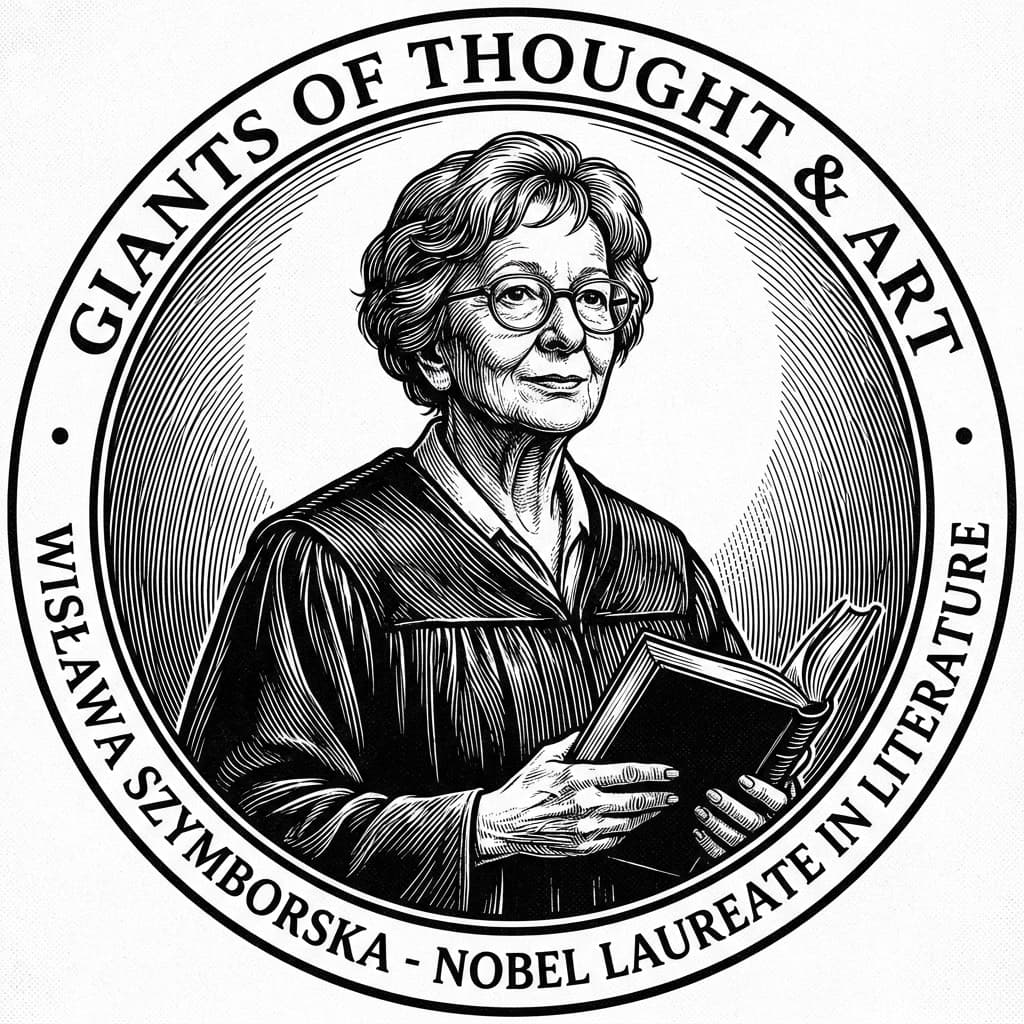
Wisława Szymborska
1923–2012
The 'Mozart of poetry' — with something of Beethoven's fury
When Wisława Szymborska won the Nobel Prize in Literature in 1996, her friends jokingly called it 'the Stockholm tragedy' — not because she didn't deserve it, but because the shy, ironic poet from Kraków was so overwhelmed by the attention that she couldn't write a poem for two years.
She published barely 350 poems in her lifetime. Asked why so few, she answered: 'I have a trash can in my home.' That answer is the best possible introduction to her poetry: modest, precise, and quietly lethal.
A Life in Kraków
Szymborska was born in 1923 in Kórnik, near Poznań, but her family moved to Kraków when she was eight, and she never really left. She survived the war attending secret classes and working as a railway clerk, then studied literature and sociology at the Jagiellonian University — without bothering to take a degree.
For decades she worked at the Kraków literary weekly Życie Literackie, editing poetry and writing a beloved column of book reviews called 'Non-required Reading' — short essays on everything from gardening manuals to statistics textbooks.
The Art of the Question
Szymborska's poems start from the smallest things — an onion, a cat waiting in an empty apartment, a grain of sand — and end at the biggest questions, usually with a smile that stings. The Nobel committee praised her 'ironic precision'; the announcement famously described her as the 'Mozart of poetry' with 'something of the fury of Beethoven'.
Her Nobel lecture was built around three small words. Real poets and real scientists, she argued, are the people who keep repeating 'I don't know' — because each such admission is the start of the next discovery.
The Reluctant Celebrity
She avoided literary pomp all her life. She loved kitsch souvenirs, collected absurd postcards, made surreal handmade collages that she mailed to friends, and ran a small lottery of silly prizes at her dinner parties.
She died in Kraków in 2012, in her sleep, working to the end on new poems. Her verse keeps escaping the bookshelf: 'Nothing Twice' has been turned into a hit song more than once, decades apart.
Nothing can ever happen twice. In consequence, the sorry fact is that we arrive here improvised and leave without the chance to practise.
Curious Facts
- She published only about 350 poems in six decades; asked why, she replied: 'I have a trash can in my home.'
- Her Nobel lecture praised the phrase 'I don't know' as the inspiration behind all real poets and scientists.
- Friends jokingly called her Nobel Prize 'the Stockholm tragedy' — the fame blocked her writing for two years.
- For decades she handmade surreal collage postcards and mailed them to friends.
- Her poem 'Nothing Twice' became a Polish rock hit — twice, decades apart.
 Support this project