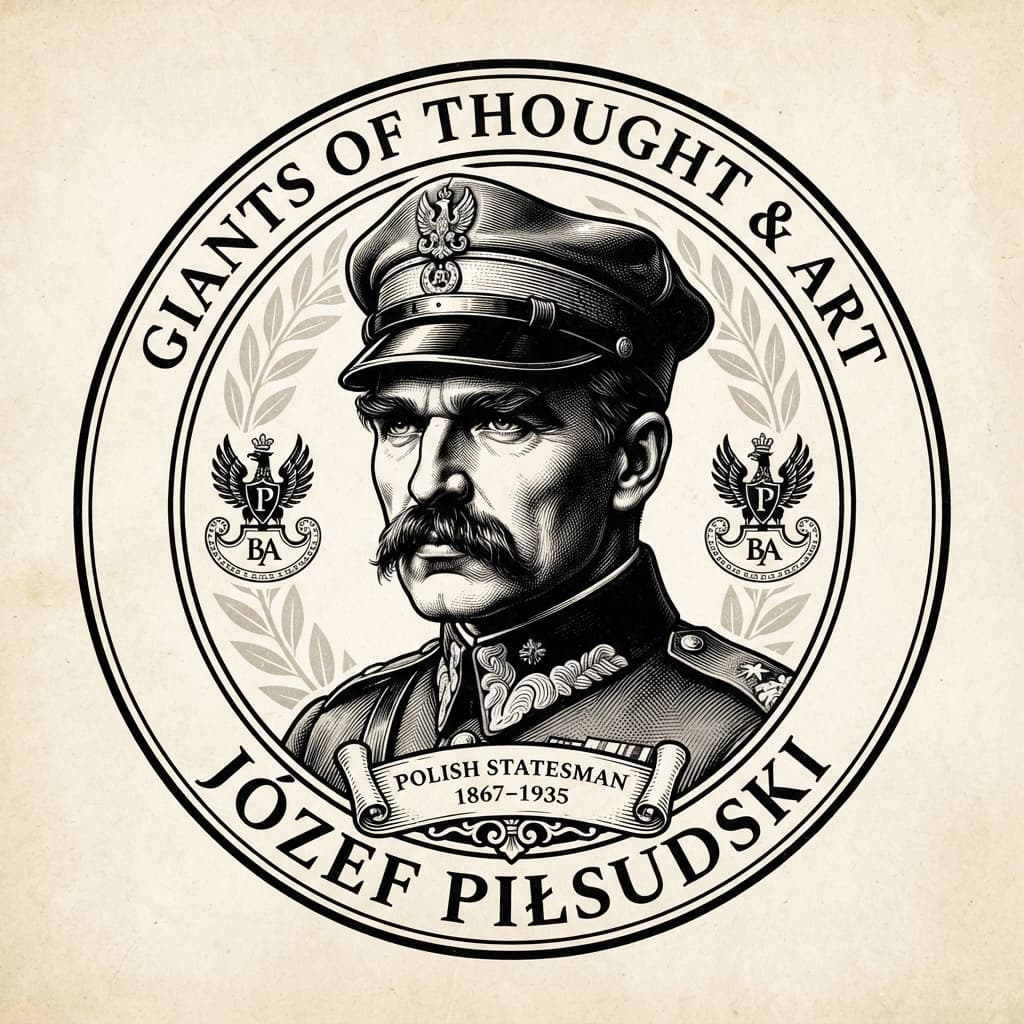
In November 1918, after 123 years of partition between three empires, Poland reappeared on the map of Europe. If one person can be said to have willed that moment into existence, it was Józef Piłsudski — a former revolutionary who robbed a tsarist train, raised his own legions, and became the father of the Second Polish Republic.
Piłsudski is not a simple hero. He was a socialist who abandoned socialism — 'I took the red tram to the stop called Independence, and there I got off' — and a democrat who later staged a coup. But 11 November, Poland's Independence Day, is unthinkable without him.
The Conspirator
Piłsudski was born in 1867 near Vilnius, into patriotic gentry that raised him on the memory of failed uprisings. At nineteen he was exiled to Siberia for five years, loosely implicated in a plot against the tsar. He returned a hardened conspirator, joined the Polish Socialist Party and spent years printing its underground newspaper on a hidden press.
In 1908 he personally led the famous raid at Bezdany, holding up a Russian mail train to fund the independence movement. Among the small band of raiders were three future prime ministers of Poland — and one future head of state.
Legions and Independence
When the First World War broke out, Piłsudski's Polish Legions fought against Russia — but he refused to make Polish soldiers swear loyalty to the German Kaiser in 1917. For that, the Germans locked him in the fortress of Magdeburg, which conveniently cleansed him of any suspicion of collaboration.
Released as the war collapsed, he arrived in Warsaw on 10 November 1918. The next day the city's German garrison was disarmed and Piłsudski was handed military command — the date now celebrated as Independence Day. He then faced the absurd task of stitching one country out of three legal systems, several currencies and three railway gauges.
The Miracle on the Vistula
In 1920 the Red Army stood at the gates of Warsaw, expecting to carry the revolution onward to Germany. The Polish counteroffensive in August — remembered as the 'Miracle on the Vistula' — shattered the Soviet advance and is often ranked among the most decisive battles in European history.
Piłsudski withdrew from politics, then returned by force in the May Coup of 1926, ruling from behind the scenes until his death in 1935 — a legacy Poles still debate. He was buried among kings at Wawel Cathedral in Kraków, but his heart, at his own request, lies in Vilnius, in his mother's grave.
To be defeated and not submit, is victory; to be victorious and rest on one's laurels, is defeat.
Curious Facts
- In 1908 he led an armed raid on a Russian mail train at Bezdany; three of his accomplices later became prime ministers of Poland.
- His imprisonment by the Germans in 1917–18 made him politically untouchable — he reached Warsaw the day before independence.
- The 1920 Battle of Warsaw is often listed among the most decisive battles in world history.
- He summed up his break with socialism: 'I took the red tram to the stop called Independence — and got off.'
- His body rests among Polish kings at Wawel, but his heart is buried in Vilnius, in his mother's grave.
 Support this project