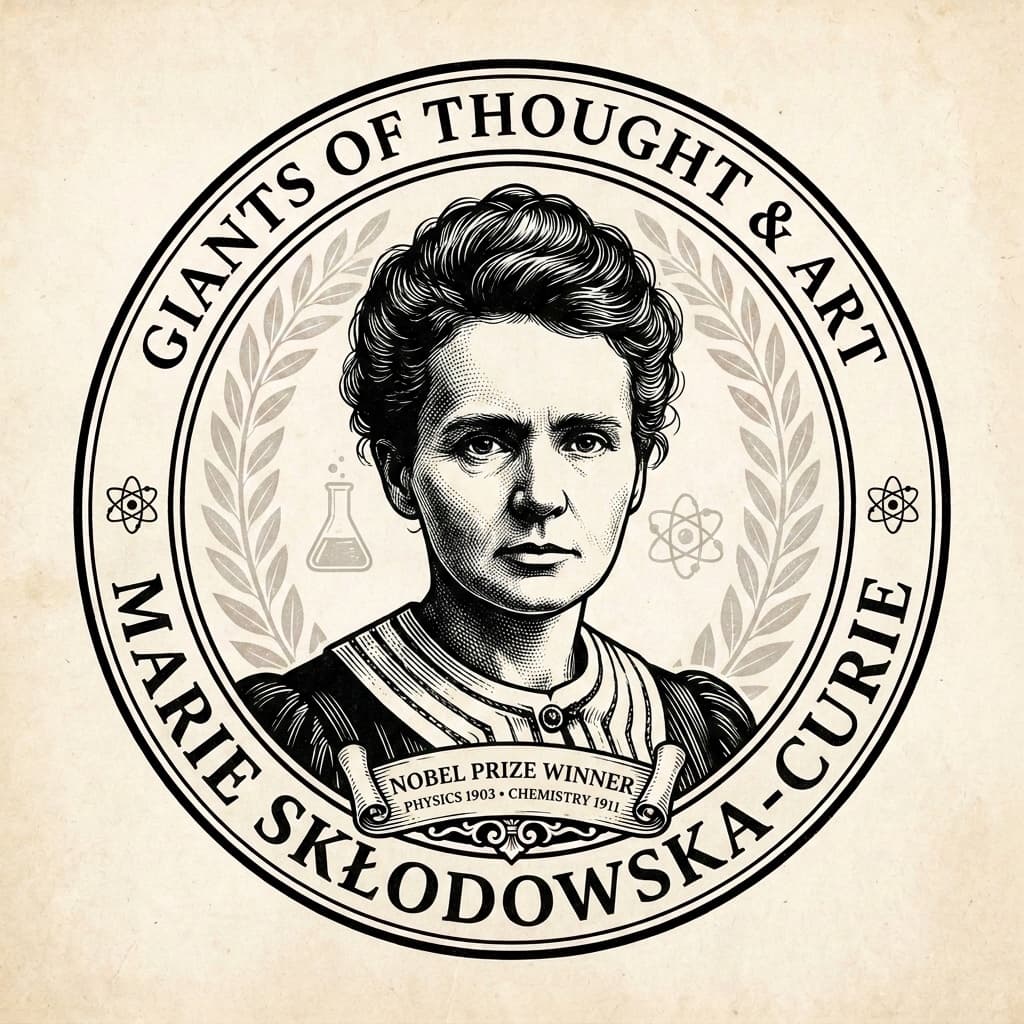
Before she was Madame Curie, she was Maria Skłodowska — a Warsaw girl who was not allowed to attend university, both because she was a woman and because her country officially did not exist. So she studied in secret, at an illegal night school that kept changing addresses to dodge the tsarist police. They called it the Flying University.
She would go on to become the first woman to win a Nobel Prize, the first person to win two, and to this day the only person honoured in two different sciences. Not bad for someone who spent years working as a governess to pay for her sister's studies.
Warsaw, in Secret
Maria was born in 1867 in a Warsaw under Russian rule, where Polish language and history were pushed out of schools. Her father, a physics and mathematics teacher, kept science alive at home. With universities closed to women, Maria made a pact with her sister Bronia: she would work as a governess to fund Bronia's medical studies in Paris, and then they would swap.
In 1891, aged twenty-four, she finally boarded the train to Paris. She enrolled at the Sorbonne under the French name Marie, lived in a freezing garret, occasionally fainted from hunger — and finished first in her physics degree.
Polonium, Radium, and a Leaky Shed
With her husband Pierre Curie, Marie set out to investigate the mysterious rays given off by uranium — a phenomenon she named 'radioactivity'. Working in a leaky wooden shed, they processed tonnes of pitchblende ore by hand, stirring boiling vats with an iron rod nearly as tall as Marie herself.
In 1898 they announced two new elements: polonium, defiantly named after her homeland that was missing from the map, and radium. The 1903 Nobel Prize in Physics nearly went to Pierre and Henri Becquerel alone — until Pierre insisted the committee include Marie. After Pierre's tragic death in 1906, she took over his professorship, becoming the first woman ever to teach at the Sorbonne, and in 1911 won a second Nobel, this time in chemistry.
Little Curies and a Heavy Price
When the First World War broke out, Marie built mobile X-ray units — nicknamed 'petites Curies' — and drove them to the front line herself, training her teenage daughter Irène as an assistant. An estimated million wounded soldiers were examined thanks to them.
The decades of radiation exposure eventually caught up with her: she died in 1934 of aplastic anaemia. Her laboratory notebooks are still radioactive today and are stored in lead-lined boxes. In 1995 she became the first woman laid to rest in the Panthéon in Paris on her own merits — carried there, fittingly, as a Polish-born scientist who never stopped signing her name Skłodowska.
Nothing in life is to be feared, it is only to be understood. Now is the time to understand more, so that we may fear less.
Curious Facts
- She named her first discovered element polonium after Poland — a country that, at the time, did not exist on any map.
- Her laboratory notebooks will remain radioactive for about 1,500 years; researchers consult them wearing protective gear.
- She refused to patent the radium-isolation process, believing scientific discoveries belong to everyone.
- During WWI she tried to donate her Nobel medals to be melted down for the war effort — the bank refused to take them.
- Her daughter Irène also won a Nobel Prize in chemistry, making the Curies the most Nobel-decorated family in history.
 Support this project