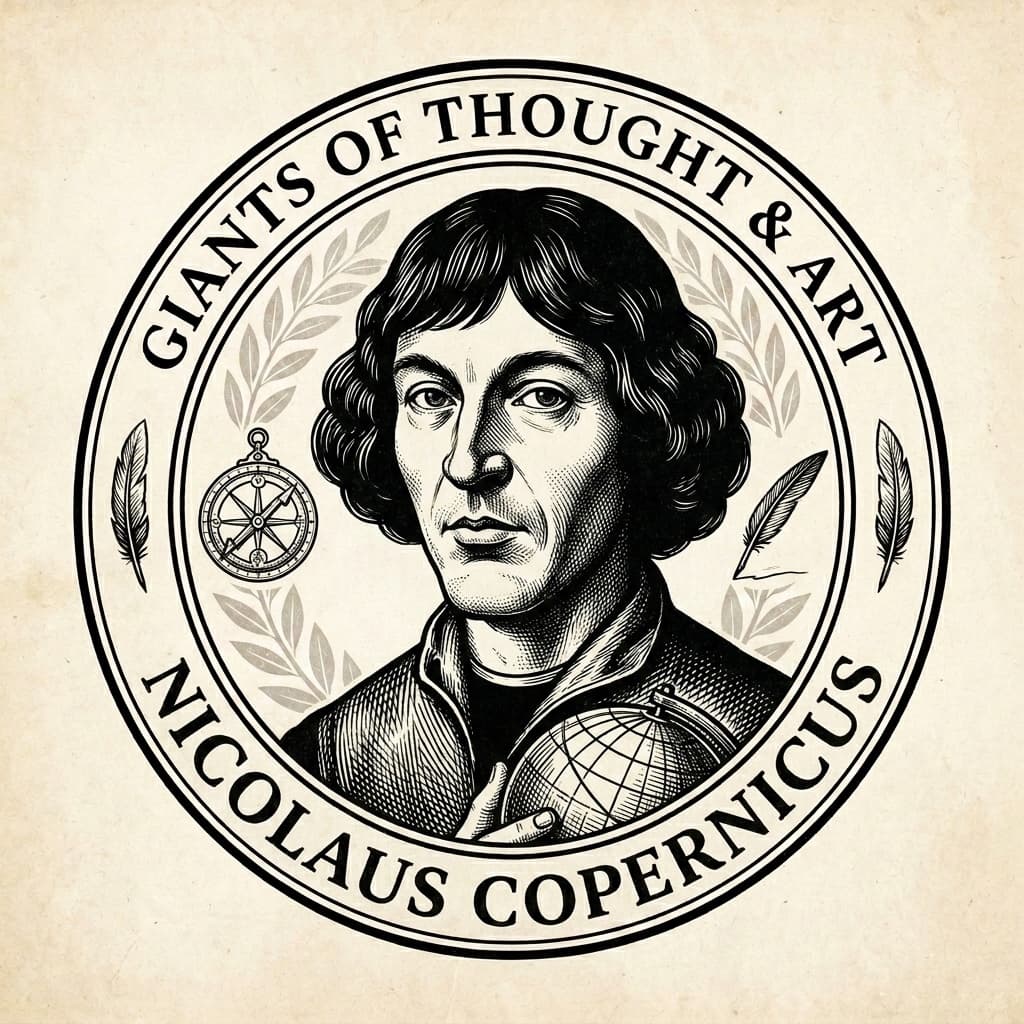
Imagine spending your whole life on a book so radical that you only dare to publish it on your deathbed. That is, more or less, the story of Mikołaj Kopernik — known to the world as Nicolaus Copernicus — a church administrator from Toruń who quietly demoted the Earth from the centre of the universe.
Copernicus was never a full-time astronomer. He was a canon of the Catholic Church, a physician, a translator, and even an economist. Astronomy was the passion he squeezed into the margins of a busy administrative life — and it changed everything.
From Toruń to the Stars
Copernicus was born on 19 February 1473 in Toruń, a prosperous Hanseatic trading town on the Vistula. When his father died, his uncle — a powerful bishop — took charge of his education and sent him to the Academy of Kraków, then to the great universities of Bologna, Padua and Ferrara, where he studied law, medicine, Greek and, on the side, the movements of the heavens.
He eventually settled in Frombork, a small cathedral town on the Baltic lagoon that he himself called 'the remotest corner of the Earth'. There, between managing church estates, practising medicine and reforming the local currency, he spent decades watching the sky — entirely with the naked eye, since the telescope would not be invented for another seventy years.
The Book That Rearranged the Heavens
For most of his life, Copernicus refined a dangerous idea: that the Sun, not the Earth, sits at the centre, and that our planet spins daily on its axis while orbiting once a year. He circulated a short manuscript summary among trusted friends, but hesitated to publish the full theory, fearing ridicule from philosophers and theologians alike.
It took a young mathematician named Rheticus, who travelled across Europe to study with him, to finally push the manuscript to the printer. 'De revolutionibus orbium coelestium' — On the Revolutions of the Heavenly Spheres — appeared in 1543. According to a famous account, a printed copy reached Copernicus on the very day he died, letting him touch his life's work at the last possible moment.
The Copernican Revolution
The model was not perfect — Copernicus still used circular orbits, and the maths remained complicated. But the shift in perspective was seismic. Galileo defended it, Kepler corrected it, and Newton explained it. Modern science, in a real sense, begins with that quiet canon in Frombork.
Today 'Copernican revolution' is shorthand for any idea that flips our perspective completely. In Poland, every schoolchild knows the rhyme: 'Wstrzymał Słońce, ruszył Ziemię — polskie wydało go plemię' — he stopped the Sun, he moved the Earth, and it was the Polish people that gave him birth.
Wstrzymał Słońce, ruszył Ziemię — polskie wydało go plemię.
Curious Facts
- He formulated an early version of what economists now call Gresham's law — 'bad money drives out good' — decades before Gresham himself.
- All of his observations were made with the naked eye; the telescope was only invented about seventy years later.
- His grave in Frombork Cathedral was only identified in 2005, when DNA from hairs found in one of his books matched the remains.
- He studied at four universities but his doctorate was in canon law — not astronomy.
- Around 270 first-edition copies of De revolutionibus survive today, and historians track every single one of them.
 Support this project