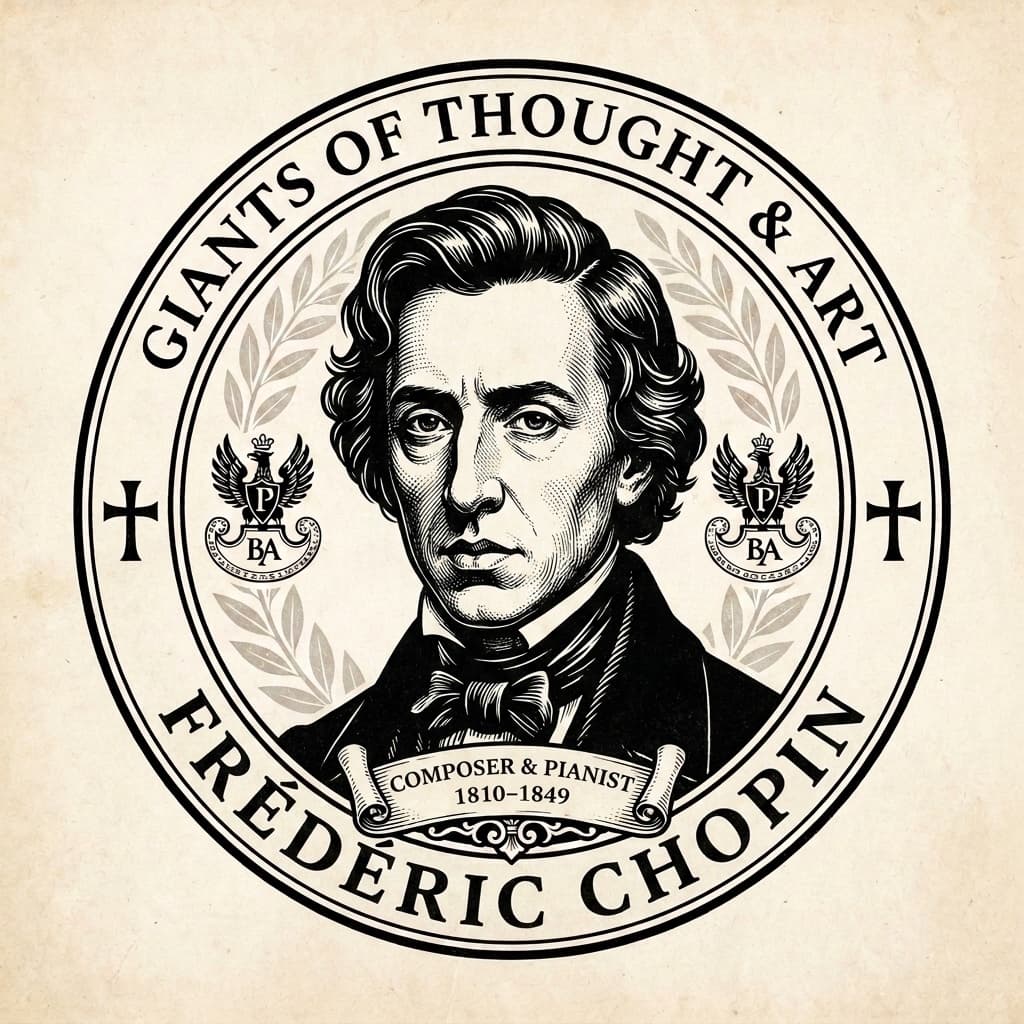
Inside a pillar of the Holy Cross Church in central Warsaw, behind a stone tablet, rests a jar containing a human heart. It belongs to Fryderyk Chopin — smuggled from Paris to Warsaw by his sister, reportedly in a jar of cognac, because his dying wish was for his heart to return home.
Chopin left Poland at twenty and never came back, but nobody has ever put more Poland into music. His mazurkas and polonaises carried the rhythms of Polish villages into the grandest salons of Europe — and, in the darkest chapters of Polish history, they carried something like hope.
A Prodigy from Żelazowa Wola
Fryderyk Chopin was born in 1810 in Żelazowa Wola, a village west of Warsaw, to a French father and a Polish mother. He was composing polonaises at seven and playing for Warsaw's aristocracy as a child; newspapers compared him to Mozart.
In November 1830, aged twenty, he left Warsaw to launch his career abroad. His friends gave him a silver goblet filled with Polish soil. Weeks later, the November Uprising against Russia broke out — and was crushed. Chopin never saw Poland again.
The Paris Years
In Paris, Chopin became the most sought-after piano teacher of the aristocracy and a legend of the salons — while giving only around thirty public concerts in his entire life. Large halls, he confessed, frightened him; his music was made for rooms where you could hear a page turn.
His stormy relationship with the novelist George Sand produced his most productive years, including the Preludes, largely written during a rain-soaked, disastrous winter on Majorca. All the while, tuberculosis was slowly consuming him.
A Heart in Warsaw
Chopin died in Paris in 1849, aged just thirty-nine. At his funeral, the Polish soil from that silver goblet was sprinkled over his grave at Père Lachaise. His sister Ludwika then carried out his last wish, secretly bringing his heart back to Warsaw through Russian-controlled borders.
Poland has repaid the devotion. The Chopin International Piano Competition, held in Warsaw every five years, is one of music's greatest events; the city's airport bears his name; and on benches across Warsaw, you can press a button and hear his nocturnes exactly where he once walked.
Simplicity is the final achievement. After one has played a vast quantity of notes, it is simplicity that emerges as the crowning reward of art.
Curious Facts
- Warsaw has 'musical benches' at places connected to his life — press a button and they play Chopin.
- He gave only around thirty public concerts in his career, preferring intimate salon performances.
- His heart rests in Warsaw's Holy Cross Church, smuggled from Paris by his sister — reportedly in a jar of cognac.
- Warsaw's international airport is named after him — likely the only major airport named after a Romantic composer.
- During WWII the Nazi occupiers banned public performances of Chopin — his music was considered dangerously Polish.
 Support this project