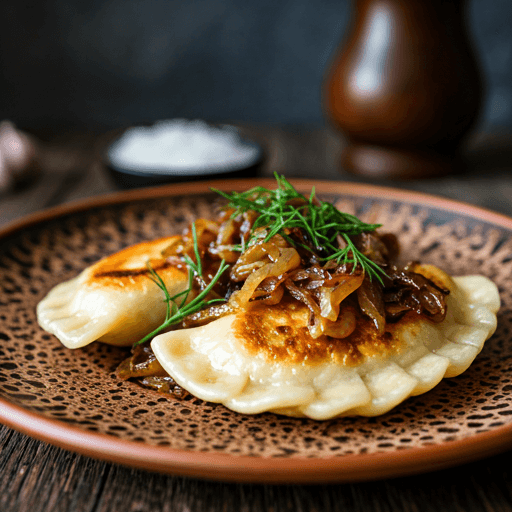
Ask a Pole abroad what they miss most and there is a good chance the answer is a plate of pierogi — soft half-moons of dough hiding potato and cheese, or meat, or wild mushrooms, drenched in fried onions. Pierogi are not just food in Poland; they are homesickness in edible form.
Every family swears by its own recipe. The dough must be rolled thin but never tear, the filling seasoned just so, the edges pinched into a neat braid — and grandmothers judge all three at a glance. Learning to fold pierogi properly is practically a rite of passage.
From Monastery Kitchens to National Symbol
Dumplings travelled to Poland along medieval trade routes from the East, and by the 13th century they were already at home in Polish kitchens. Legend credits Saint Hyacinth of Kraków — Święty Jacek — with feeding villagers pierogi during a famine, which is why Poles still exclaim 'Święty Jacku z pierogami!' ('Saint Hyacinth with his pierogi!') when something astonishing happens — roughly the Polish 'holy cow!'.
For centuries pierogi were peasant food, made from cheap flour and whatever the season offered. Different shapes and fillings marked different occasions: kurniki, large wedding pierogi with chicken, or knysze, baked for funerals. Somewhere along the way, the humble dumpling became the most recognisable dish of Polish cuisine.
How They Are Made
The dough could not be simpler — flour, warm water, a pinch of salt, sometimes an egg — but texture is everything: supple enough to roll thin, strong enough to hold the filling. Circles are cut with a glass, filled, folded in half and pinched shut, ideally with a decorative braided edge.
The classics: ruskie (potato, farmer's cheese, and onion — 'Ruthenian', from the historic Red Ruthenia region, not Russian), minced meat, sauerkraut with wild mushrooms, and sweet versions with blueberries, strawberries, or sweet cheese. Pierogi are boiled until they float, then — in the best households — finished in a pan with butter until golden, and topped with okrasa: fried onion, bacon bits, or a spoon of sour cream.
When Poland Eats Them
Pierogi appear everywhere: in milk bars (bary mleczne, the beloved canteens serving cheap homestyle food), at roadside restaurants, and at every family gathering. On Christmas Eve, meatless pierogi with sauerkraut and mushrooms are one of the twelve traditional wigilia dishes, and tiny pierogi-like uszka ('little ears') float in the beetroot barszcz.
In summer, sweet fruit pierogi with cream and sugar count as a full dinner — a concept many visitors need a moment to accept. And every August, Kraków throws a multi-day Pierogi Festival where cooks compete for the statuette of Saint Hyacinth.
Curious Facts
- The word 'pierogi' is already plural — a single dumpling is a 'pieróg'. Ordering 'one pierogi' amuses Poles endlessly.
- 'Ruskie' pierogi are named after historic Red Ruthenia, not Russia; after 2022 many restaurants pointedly renamed them 'Ukrainian pierogi'.
- Poles exclaim 'Święty Jacku z pierogami!' — 'Saint Hyacinth with his pierogi!' — as an expression of astonishment.
- Kraków's annual Pierogi Festival crowns its winner with a statuette of Saint Hyacinth.
- Traditional etiquette allows — even encourages — eating fried pierogi with your hands at festivals; at grandma's table, fork only.
 Support this project