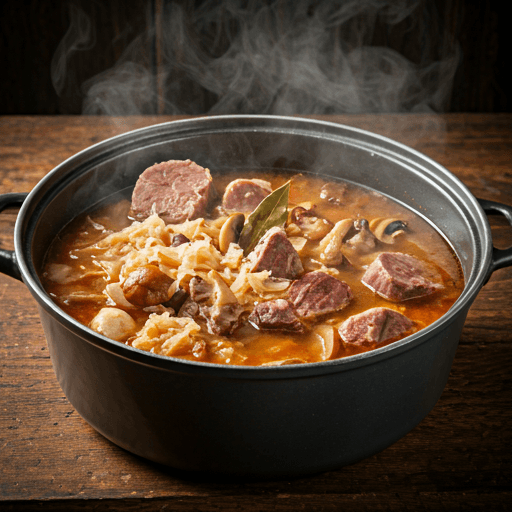
There is a rule about bigos every Pole knows: it is never ready on the first day. The famous hunter's stew of sauerkraut, fresh cabbage, and several kinds of meat is cooked, cooled, and reheated over days — and each reheating makes it deeper, darker, and better. Bigos is less a recipe than a process.
It is also the only dish with its own scene in Poland's national epic. In 'Pan Tadeusz', Adam Mickiewicz interrupts the plot to rhapsodise about bigos steaming over a hunters' fire — 'in words it cannot be expressed', he writes, before spending a dozen lines trying anyway.
A Dish of Nobles and Hunters
Bigos goes back to the kitchens of the Polish-Lithuanian Commonwealth, where it was a fixture of hunting parties and noble feasts. A cauldron of bigos travelled well, improved with age, and could absorb whatever game the hunt provided — venison, boar, hare — alongside farm meats and sausage.
Because it kept for days without refrigeration and only gained flavour, bigos became the ultimate winter travel food: carted to sleigh parties, carnival balls, and week-long hunts. Old cookbooks casually recommend making enough for a week.
How It Is Made
The base is two cabbages: sauerkraut for sourness and fresh cabbage for sweetness. Into the pot go several meats — typically pork, beef, kiełbasa, and bacon, the more variety the better — plus dried forest mushrooms, prunes, onions, and a glass of red wine or madeira. Some families add juniper berries, allspice, or a spoon of honey.
Then comes the real ingredient: time. Bigos simmers for hours, rests overnight, and is reheated again and again — three days is considered a respectable minimum. There is no canonical recipe; 'as many houses, so many bigoses', the saying goes, and arguments about prunes are a national sport.
When Poland Eats It
Bigos is cold-weather food: the pot appears at Christmas and New Year's Eve, on All Saints' Day after long cemetery visits, and at any winter gathering that needs feeding in bulk. It is traditionally served simply, with rye bread or boiled potatoes and, among adults, a chilled glass of vodka.
Because it survives — indeed improves with — repeated reheating, bigos is also the dish Poles take to cabins, ski trips, and hunting lodges. Many families still make a Christmas batch big enough to last into January, frozen in portions like edible savings.
Curious Facts
- Adam Mickiewicz devoted a loving passage of the national epic 'Pan Tadeusz' (1834) to bigos steaming at a hunt.
- The idiom 'narobić bigosu' — 'to make bigos' — means to cause a big mess or stir up trouble.
- Purists insist real bigos contains no water and no roux — only cabbage, meat, and patience.
- Bigos is deliberately cooked days ahead: the flavour peaks around the third reheating.
- In old Poland, a frozen barrel of bigos was standard winter travel provision — chunks were hacked off and reheated on the road.
 Support this project