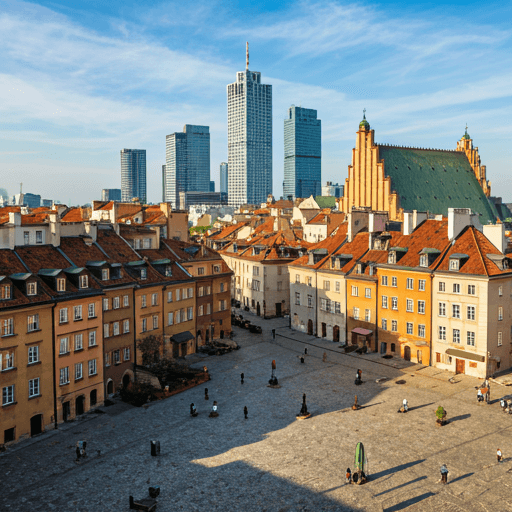
A City Reborn
Warsaw became the capital of Poland in 1596 when King Sigismund III Vasa moved the royal court from Kraków. Strategically positioned at the heart of the Polish-Lithuanian Commonwealth, the city grew into a major cultural and political centre over the following centuries.
During World War II, the Nazis systematically destroyed 85% of the city following the 1944 Warsaw Uprising — a 63-day armed revolt by the Polish resistance. After the uprising was crushed, Hitler ordered Warsaw to be razed to the ground. By January 1945, barely a wall was left standing.
What followed is one of history's greatest acts of collective will: Varsovians rebuilt their city from historical paintings, photographs, and memory. The Old Town was reconstructed so faithfully that UNESCO added it to the World Heritage List in 1980 — a unique case of a reconstructed historic centre receiving that honour.
Curious Facts
- Warsaw is one of the greenest capitals in Europe — over 30% of the city is covered by parks, forests, and green spaces.
- The Old Town was entirely reconstructed after WWII using 18th-century paintings by Bernardo Bellotto as blueprints, and is now a UNESCO World Heritage Site.
- The Palace of Culture and Science, a Stalinist skyscraper gifted by the Soviet Union, remains Warsaw's tallest building and its most debated landmark.
- Frédéric Chopin was born near Warsaw. Every summer Sunday, free outdoor Chopin concerts are held beneath the willows of Łazienki Park.
Travel Guide
- Buy a 24- or 48-hour public transport card — trams and the metro cover all major sights efficiently.
- The Old Town is beautiful but touristy; cross the Vistula to explore Praga district for authentic Warsaw street art and craft breweries.
- Most national museums offer free admission on Sundays.
- Milk bars (bar mleczny) serve hearty Polish meals for under €3 — look for the retro signage.
What to Visit
Old Town Market Square
The meticulously reconstructed 13th-century heart of Warsaw, ringed by colourful burgher houses and crowned by the famous mermaid fountain.
Warsaw Uprising Museum
One of Europe's finest war museums, chronicling the 63-day 1944 uprising with immersive exhibits, original artefacts, and a deeply moving atmosphere.
Łazienki Park
A vast royal park with the Palace on the Water, peacocks roaming freely among the paths, and free Chopin concerts on summer Sundays.
POLIN Museum
Award-winning museum of the history of Polish Jews, located in the former Jewish Ghetto district, with a stunning interactive narrative spanning 1,000 years.
 Support this project