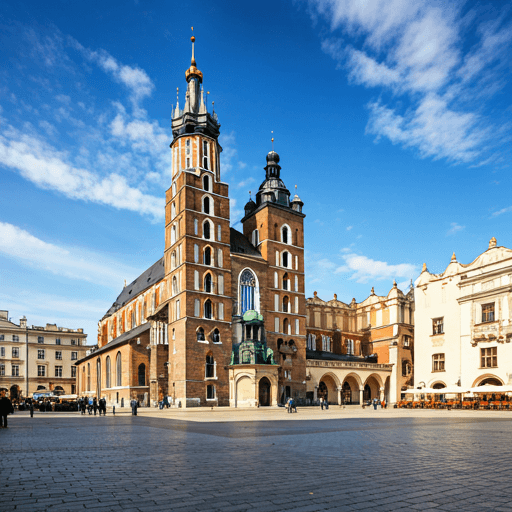
Poland's Eternal Capital
Kraków has been continuously inhabited since the 7th century, growing around the legendary Wawel Hill where, according to myth, Prince Krak slew a fire-breathing dragon. The city became Poland's capital in the 11th century under the Piast dynasty and remained the royal seat for over 500 years.
When King Sigismund III moved the capital to Warsaw in 1596, Kraków retained its status as the coronation city. Polish kings continued to be crowned — and buried — at Wawel Cathedral, giving the city a sacred, irreplaceable role in national identity that persists to this day.
Kraków's greatest modern fortune was survival. Unlike Warsaw, the city emerged from World War II largely intact. The German governor Hans Frank chose Wawel Castle as his headquarters, inadvertently protecting the historic centre. Today Kraków's Old Town is one of Europe's best-preserved medieval urban landscapes and a UNESCO World Heritage Site.
Curious Facts
- The Wawel Dragon legend is very much alive: a fire-breathing steel dragon sculpture at the foot of Wawel Hill breathes real flames every few minutes.
- The Jagiellonian University, founded in 1364, is one of the oldest universities in the world. Nicolaus Copernicus studied here.
- Every hour, a bugle call (hejnał) is played from the tower of St Mary's Basilica — and it stops mid-note, commemorating a medieval trumpeter shot by a Mongol arrow.
- Nowa Huta, a district built by the communists in the 1950s as a model socialist city, is now a fascinating architectural time capsule and tourist attraction.
Travel Guide
- The Kraków Card gives unlimited public transport and free entry to dozens of museums — great value for a 2–3 day stay.
- Walk the Royal Road from the Barbican, through the Old Town, and up to Wawel Castle for the best introduction to the city.
- Book the Wieliczka Salt Mine in advance — it's the most visited attraction in Poland and tours sell out quickly.
- Avoid restaurants directly on the Main Market Square; one street back you'll find better food at half the price.
What to Visit
Wawel Castle & Cathedral
The hilltop royal residence that served as Poland's seat of power for centuries, housing priceless art collections and the crypts of Polish kings.
Main Market Square (Rynek Główny)
One of the largest medieval squares in Europe, dominated by the Cloth Hall and St Mary's Basilica, and alive with street musicians and café terraces.
Kazimierz — The Jewish Quarter
A neighbourhood with a thousand-year Jewish history, now full of vibrant cafés, galleries, and synagogues — the backdrop for Schindler's List.
Wieliczka Salt Mine
A UNESCO World Heritage Site of underground chapels, sculptures, and lakes carved entirely from salt by miners over 700 years.
 Support this project